
The photographer had just raised her camera when my mother-in-law, Linda, looked straight at me and said, “You should step out of this one. It’s just for real family.”
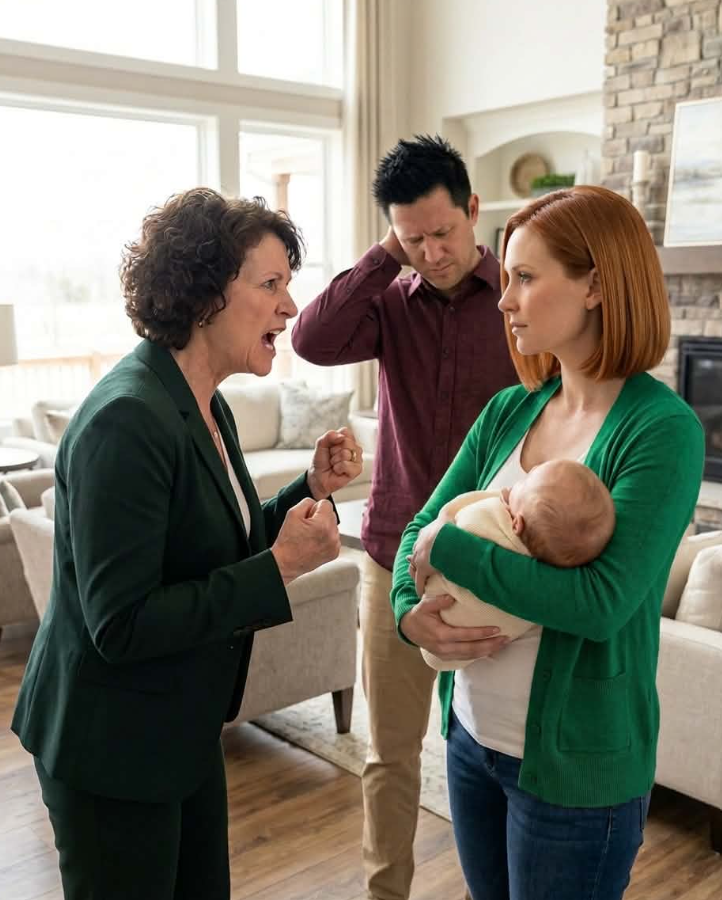
The room went silent in that uncomfortable way it does when something cruel is said too plainly to ignore. My newborn son slept against my chest, wrapped in a pale blue blanket, his tiny face pressed into me—warm, trusting, unaware. We were standing in the living room where I had given birth just six weeks earlier: still sore, still exhausted, still trying to understand how I could feel so broken and so full at the same time.
I waited for my husband to speak.
Daniel stood beside his father, one hand in his pocket, the other hanging uselessly at his side. He looked at his mother, then at the photographer, then down at the floor. He said nothing.
Linda gave me a tight, practiced smile. “We’re not trying to upset you, honey. We just want one nice picture with the immediate family.”
Immediate family.
I stared at her, certain I had misheard. I was the one bleeding in this house, feeding a newborn in this house, waking every two hours in this house. I was the one whose name was on the deed, whose savings had made this home possible, whose credit had kept us afloat when Daniel’s business collapsed into debt. And yet here she was, erasing me in my own living room as if I were temporary.
“Mom,” Daniel said quietly—but without conviction. Not stopping her. Just hoping the moment would pass.
Linda sighed. “Don’t make a scene. Sarah can take the next one.”
Sarah. Not wife. Not mother of the baby in my arms. Just Sarah.
The photographer lowered her camera. Daniel’s sister looked away. His father pretended to check his phone.
Something inside me went still.
Not broken. Not emotional. Still.
I stepped out of the frame exactly as she asked. I even smiled. Linda looked satisfied, like she had won something small but important. Daniel took my place beside her. The camera flashed. They all smiled like it was a holiday card.
Then I turned to the photographer.
“Could you take one of me and my son alone? In front of the fireplace?”
Linda blinked. “Excuse me?”
I shifted my baby slightly and met her eyes. “Since we’re organizing photos by ‘real family,’ let’s start with the owners of the house.”
Silence snapped through the room.
Linda’s face tightened. “What does that mean?”
The photographer froze, clearly regretting everything. Daniel looked confused, like I had started speaking a language he didn’t know.
I didn’t raise my voice.
“It means this house was purchased with my inheritance, financed under my credit, and is legally in my name. So if we’re deciding who counts as family here, we should be very precise.”
Daniel stepped forward. “Sarah, not now.”
I laughed once—flat, humorless. “Not now? Your mother just told me to step out of a photo with my own child, and you think ‘not now’ is the response?”
Linda crossed her arms. “You’re being dramatic.”
“No,” I said. “I’m being corrected. Finally.”
Her expression hardened. “This is Daniel’s home too.”
“It’s where Daniel lives,” I replied. “That’s not the same thing.”
The words hung there.
Because they were true—and everyone knew it.
For years I had treated this house like ours, because I believed marriage meant building together. I had never used ownership as power. I didn’t need to. Or at least, I hadn’t thought I did.
But in that moment, watching my husband stay silent while I was erased in front of my child, something shifted. I understood something I had refused to admit: I had been protecting a man who did not protect me.
“Everyone needs to leave,” I said.
Daniel stared at me. “You can’t be serious.”
“I am.”
Linda gave a sharp laugh. “This is what happens after childbirth. Emotional instability.”
That landed differently.
Not because it hurt—but because it clarified everything.
All the small humiliations suddenly aligned: the dismissive comments, the constant corrections, the way I was always “too sensitive,” “too much,” “overreacting.” And Daniel’s response to all of it: “That’s just how she is.”
No.
This was what happens when someone finally stops accepting disrespect as normal.
I looked at Linda. “This is what happens when women stop calling humiliation peace.”
Then I turned to Daniel.
“You can stay. I’m not throwing you out tonight. But your parents leave now. And if you ever stand there again while someone disrespects me in front of our son, you can leave too.”
Linda looked at Daniel, expecting him to intervene.
He didn’t.
Eventually, they left. Loud footsteps. A door that shut harder than necessary.
And then there was quiet.
Real quiet.
I carried my son to the nursery. He stirred once, then settled. I kissed his forehead and stayed there a moment longer than I needed to.
When I returned, Daniel was still standing in the living room.
“You embarrassed me,” he said.
I almost laughed. “Your mother tried to remove me from my own child’s memory, and your concern is embarrassment?”
“She didn’t mean it like that.”
“Then explain what she meant.”
He couldn’t.
That was the problem.
He never could.
“Do you know what the difference is between you and her?” I asked.
He didn’t answer.
“She knows exactly what she’s doing. You just let her do it.”
His face tightened. “I was trying to avoid conflict.”
“That’s not avoidance,” I said quietly. “That’s surrender.”
He flinched, but didn’t argue.
Because it was true.
“I need you to understand something,” I continued. “This isn’t about one photo. It’s about every time you stayed silent when I needed you to speak.”
The room felt different now—not explosive, just exposed.
Daniel finally looked at me properly, like he was seeing something he hadn’t prepared for.
“What do you want me to do?” he asked.
“Decide who you are,” I said. “A husband and father—or a son who never says no.”
Two days later, he asked his mother for an apology.
She refused.
She blamed me instead.
And for the first time, Daniel ended the call.
A week later, he started therapy on his own.
I met with a lawyer—not out of anger, but clarity. I needed to understand reality without emotion clouding it. The answer was simple: the house was mine. Legally. Undeniably.
It didn’t feel like victory.
It felt like stability.
Because the real change wasn’t property.
It was perception.
Once you see a situation clearly, you can’t unsee it.
Months later, things were different. Not perfect—but different. Daniel began setting boundaries he had avoided for years. Linda remained distant, still refusing to apologize.
The photo from that day was never printed.
The one above the fireplace now is just me and my son. Simple. Soft light. No audience. No performance.
He is asleep in my arms.
And I look like someone who is no longer asking to be included.